Truffaire Systems
Frontier systems.
ARCORA
Your crop has a problem. Here's exactly what to do.
A precision crop disease diagnosis platform deployed with 15+ Farm Producer Organisations across Karnataka. Upload a photo. Get a full scientific diagnosis, treatment protocol, and economic impact — in under two minutes.
The Platform
Full-spectrum crop diagnosis.
For every Indian farmer.
A farmer or agronomist photographs any affected plant part — leaf, stem, fruit, flower, or root — and uploads up to six images per session. ARCORA's two-stage diagnostic engine analyses what is visually present, runs a morphological differential against a closed disease label set for that specific crop, and returns a full scientific diagnosis.
Every report includes a confidence score, severity rating, specific agrochemical treatment protocol with dosages and schedules, yield loss estimate, cost-of-inaction analysis, and a seasonal action calendar. Regional language summaries available in Kannada, Hindi, Telugu, Tamil, and Malayalam.
This is not a general advisory tool. It replaces the field consultation visit — at ₹33 per report.
183 crops covered
All major Indian crops — cereals, pulses, oilseeds, fruits, vegetables, spices, plantation, and floriculture.
All 5 plant parts
Leaf, stem, fruit, flower, and root — diagnosed in a single session with up to 6 images.
< 2-min turnaround
Full scientific diagnosis with confidence score, treatment protocol, and seasonal action plan — in under two minutes.
Replaces consultants
At ₹33 per report, ARCORA delivers agronomist-level analysis at a fraction of the cost of a field visit.
Deployed
Live in Karnataka.
Growing across Karnataka.
ARCORA is deployed with 15+ Farm Producer Organisations across Karnataka. Over 6,000 farmers in their networks have access to instant crop diagnosis. 13,500 diagnoses delivered — and growing every day.
15+
FPOs deployed across Karnataka
6,000+
Farmers in network active users
13,500+
Diagnoses delivered and growing
Access
Built for every scale of farming.
Scout
For individual farmers and agronomists
Single-diagnosis access. Pay per scan. The right entry point for farmers managing their own land.
Cooperative
For FPOs and agricultural cooperatives
Bulk diagnosis capacity for organisations managing multiple farmers across a season.
Alliance
For institutions and government bodies
Full platform access for KVKs, agricultural colleges, and government departments requiring centralised diagnosis infrastructure.
The platform is live. Available now for farmers, agronomists, and institutions.
arcora ↗CIPHER
India imports 100% of its field forensic and biometric identification equipment. CIPHER ends that dependency.
The only indigenous system in India combining multispectral forensic imaging, autonomous quadruped deployment, and multi-modal biometric identification — on a single platform.
The System
A system that enters where officers cannot.
CIPHER is a field forensic imaging and autonomous reconnaissance system built entirely in India. It enters contested environments ahead of officers, maps every surface, captures evidence, identifies subjects — and delivers a court-admissible case file to headquarters in real time.
Before CIPHER, every piece of equipment used for this work was imported. Every capability had a foreign dependency. CIPHER changes that — permanently.
The Components
Three parts. One integrated system.
01
CORE
The field forensic imaging unit. Handheld and mounted. Captures latent fingerprints under UV, detects trace evidence invisible to the naked eye, documents scenes in 3D, and identifies subjects across six biometric databases in under ten seconds.
02
ECHO
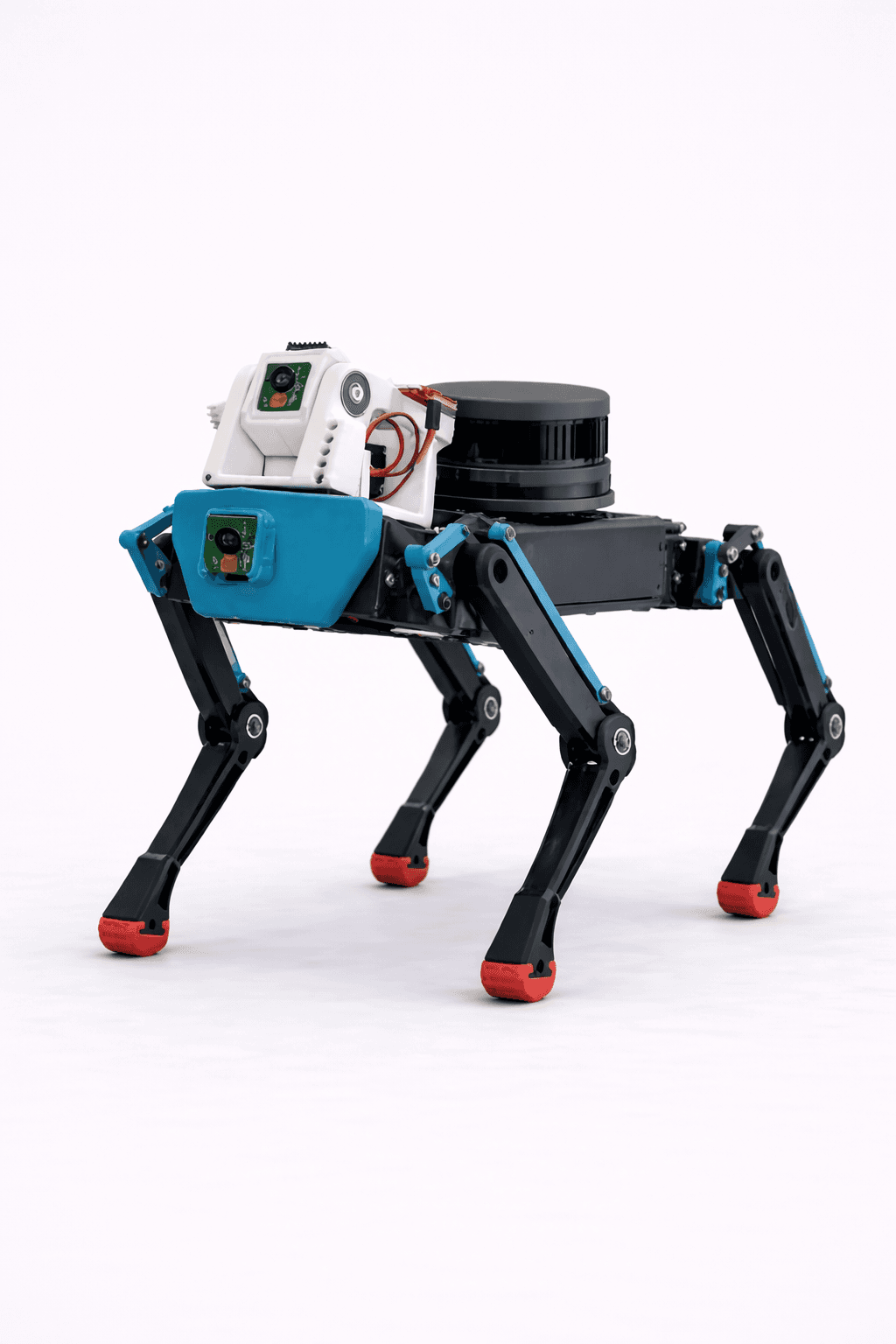
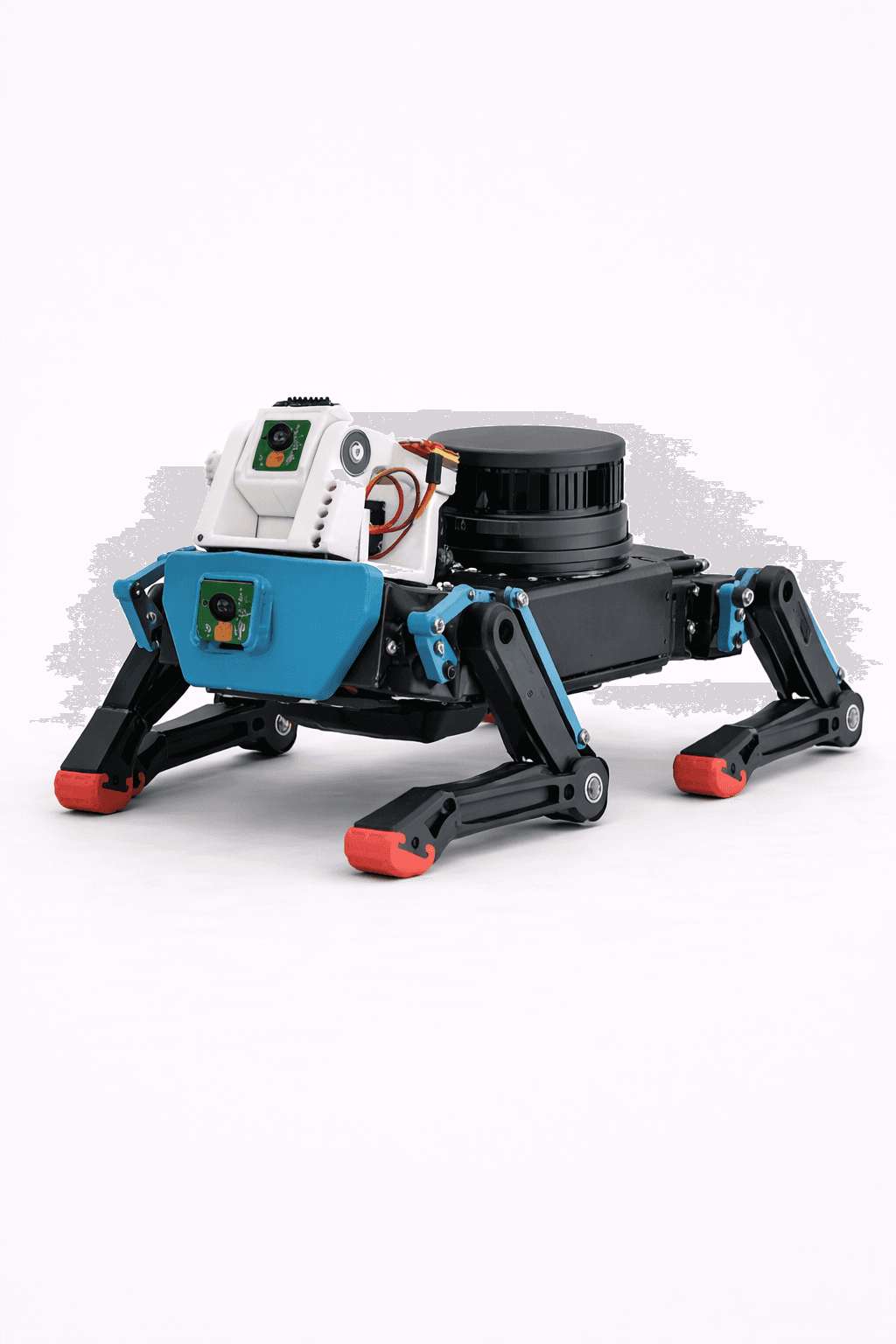
The autonomous quadruped platform — designed, engineered, and built entirely in India. ECHO navigates contested environments independently, carrying CORE into locations where deploying an officer carries unacceptable risk.
03
CIPHER Integrated
CORE mounted on ECHO. The complete operational system. ECHO navigates. CORE captures. Every surface is mapped, every piece of evidence is geo-referenced, and the officer enters only after the AI has completed its reconnaissance pass.
Four Scan Modes
One device. Every field scenario.
M1
Macro
Close-range, high-resolution capture of latent fingerprints and trace evidence — without chemicals, without contact.
M2
Spectral
Simultaneous UV, NIR, and visible imaging. Reveals biological traces, accelerants, and subsurface evidence invisible to the naked eye and standard cameras.
M3
Scene
Wide-area autonomous scanning for continuous operation on ECHO. Every surface located in space. Every piece of evidence geo-referenced and court-admissible.
M4
Biometric
Simultaneous fingerprint, face, and iris capture. Six databases queried in parallel. A match result — or auto-enrollment of an unknown subject — in under ten seconds.
Court-admissible from the moment of capture.
Every capture is SHA-256 sealed with GPS coordinates, timestamp, and officer ID at the moment of collection — before any transmission. The chain of custody is cryptographically closed in the field, not reconstructed in a lab.
CIPHER produces evidence that holds. In court. Under scrutiny. Every time.
explore cipher ↗Indigenous
Designed, engineered, and built entirely in India. No foreign platform. No imported subsystem.
No domestic competitor
No Indian company offers an integrated multispectral forensic imager with autonomous quadruped deployment. CIPHER has no indigenous equivalent.
Dual deployment
CORE operates standalone for police and forensic units. CIPHER is the combined system for defence and intelligence operations.
SYNTAX
India trains over 100,000 medical graduates annually. Most enter hospitals without a single structured clinical simulation.
A voice-first AI clinical simulation platform where students conduct complete patient encounters — from chief complaint to management — across 600+ MD-reviewed cases built for the NMC NEXT curriculum.
The Platform
A complete patient encounter. Before the real one.
SYNTAX places students inside fully simulated 3D clinical environments — outpatient rooms, emergency bays, paediatric wards, obstetric clinics. Inside each environment, they interact with an emotionally responsive AI patient through natural voice conversation, conducting a complete clinical encounter independently and without guidance.
Unlike exam preparation tools or MCQ platforms, SYNTAX recreates the actual flow of bedside medicine. Hidden symptoms, embedded red flags, evolving findings, and management-critical clues require active clinical thinking — not passive recall. The patient will not volunteer what the student does not ask.
Every case is structured against Indian clinical standards — epidemiology, drug availability, investigation access, patient literacy, and socioeconomic context drawn from real Indian hospital environments.
A Complete Clinical Encounter
Every step. Every decision. In sequence.
01
Patient Introduction
Student greets the patient, establishes rapport, and initiates the encounter through natural voice — no menus, no prompts.
02
Chief Complaint
Eliciting the presenting complaint, onset, duration, and associated symptoms through structured conversational questioning.
03
History Taking
Past history, medications, allergies, family history, and social context — systematically gathered through active inquiry.
04
Clinical Reasoning
Forming working hypotheses while uncovering hidden symptoms and embedded red flags the patient will not volunteer unprompted.
05
Examination Planning
Deciding which systems to examine, in what order, and with what clinical rationale — before any findings are revealed.
06
Investigations
Selecting appropriate investigations based on priority, Indian availability, and cost-appropriate reasoning — not reflexive ordering.
07
Emergency Recognition
Identifying life-threatening patterns and responding with the correct urgency, sequence, and clinical decision-making under pressure.
08
Management & Counselling
Definitive management planning, patient counselling, and clinical documentation — closing the encounter correctly and completely.
Clinical Coverage
600+ cases across six core specialties.
Every case individually reviewed against AIIMS, PGI, and NMC NEXT undergraduate guidelines.
What Makes It Different
Not a test. Not a tutorial. A clinical encounter.
Voice-first interaction
Students speak — the AI patient responds in natural language. No typing, no multiple choice. The interaction closely mirrors real bedside communication and adapts in real time.
Emotionally responsive AI patients
Patients demonstrate anxiety, confusion, distress, or irritability based on their condition and how the student communicates. Hidden symptoms and red flags are embedded — only competent questioning surfaces them.
Competency-based debrief
Every encounter generates a structured evaluation across history, examination, investigations, diagnostics, emergency recognition, and management — with every missed finding explicitly identified.
Available for medical institutions, colleges, and healthcare training bodies.
Get in touch ↗Not a product that gets replaced.
Not a platform that gets abandoned.
Permanent infrastructure.
Precision. Permanence. Purpose.